
The strategic value of productive chaos and skill stacking
Why breadth builds an unshakeable career.

Hi,
When I tell entrepreneurs that “good chaos brings stability,” I’m usually met with skeptical looks. It sounds like the kind of thing someone says to justify their scattered attention span.
I’m not saying it would work for every business owner, but if you are already a walking ball of chaos, then it can be strategically beneficial.
My career looks chaotic. From the outside, it probably seems unfocused, even reckless, but over enough time (and we’re talking years, not months here), patterns emerge.
Let me give you some numbers. This is my career, distilled:
1,000 finished comic pages I’ve written (plus countless more never produced)
350 produced podcast episodes
212 comic pages I’ve drawn and released
200 podcast appearances across 150+ shows
120 talks at 60+ unique conferences
55 group giveaways run for authors
50 publishing contracts signed
44 novels
40 anthology appearances
39 fashion models shot during my photography days
30 websites built
27 transmedia projects I’ve helped adapt
21 nonfiction books written or co-written
13 years with some form of representation
10 conferences hosted (including 3 in person)
8 signature courses designed and released (not counting dozens of masterclasses)
7 companies started (2 production companies, 2 telecom companies, 1 publishing company, 2 education companies, and a photography studio)
5 anthologies edited
4 projects optioned to Hollywood
3 web series directed (one started as a movie)
2 apps built
1 year as executive producer of an internet television channel
Look at that list. Does it seem focused? Does it look like someone who “stayed in their lane”?
Absolutely not, and that’s precisely the point. Long ago, when I wasn’t the best at anything, I learned about the concept of skill stacking. It posits that there are two main ways to build a durable creative career:
Become the best at one thing.
Become really good at a few things that, together, make you stand out.
Both paths work, but most people won’t reach the top 1% in any single skill. Being the best takes extreme focus, the right timing, and usually a fair amount of luck. I’ve never been particularly focused or especially lucky, so I knew I probably couldn’t ever be the first thing.
The good news? You don’t have to go that route to build something great.
You can be top 20–25% at a handful of skills—and that combination can still make you more valuable than someone who’s top 1% at just one.
That’s skill stacking.
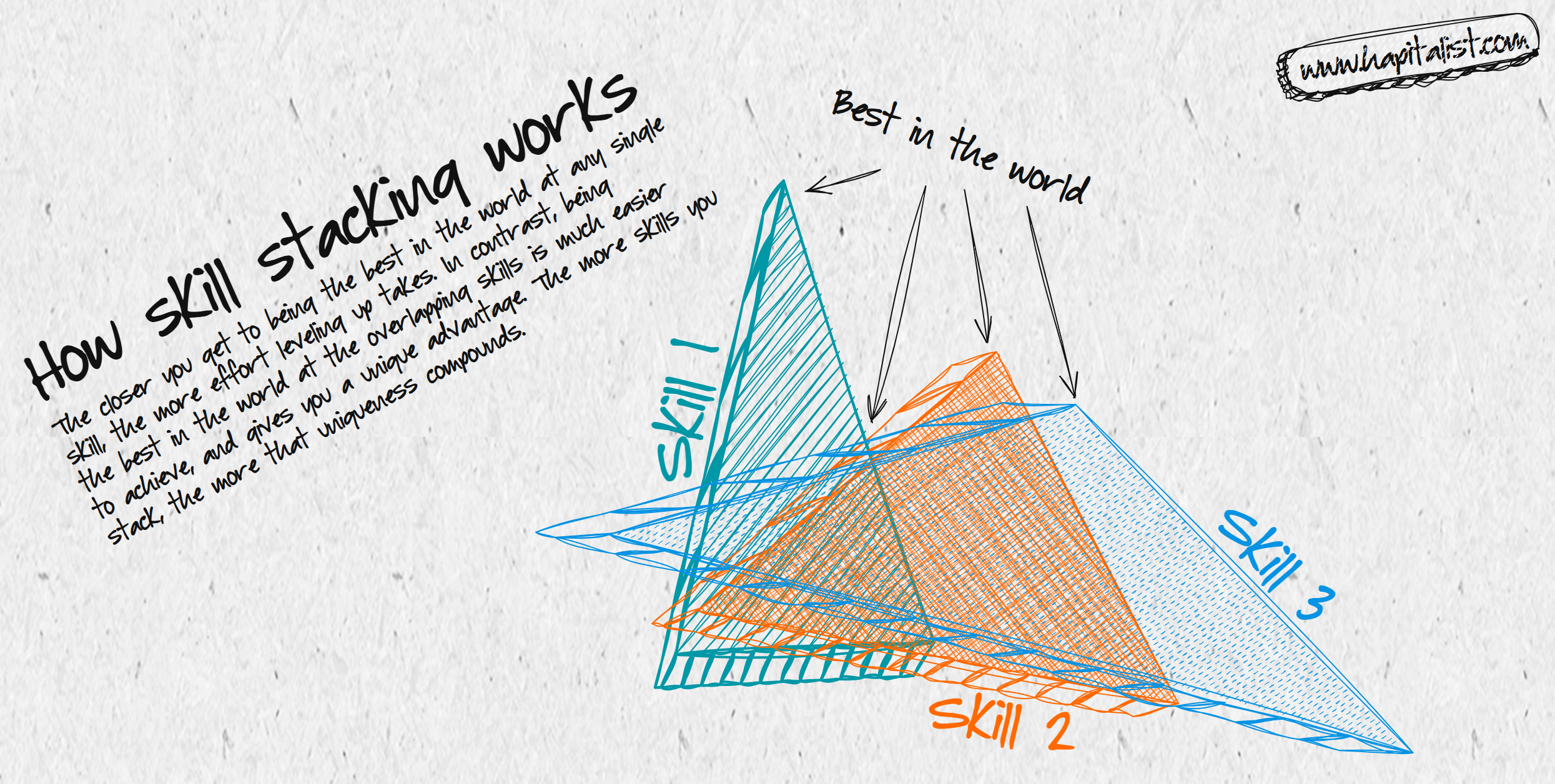
You don’t have to out-launch every founder, out-market every marketer, or out-teach every teacher. If you can do all three well enough to connect the dots? That’s a competitive edge most people simply don’t have.
I wasn’t very strategic about it, but skill stacking made intuitive sense to me. It also gave me the ability to shift between lots of different mediums, which I desperately need. Even though I love writing, I don’t want to write all the time. Whenever I am too tied to one form of expression, I start to feel itchy.
Luckily, it turned out that every new skill added leverage to the others, which made me very attractive to potential partners in recently years.
There’s very rarely something I hear in conversation where I can’t contribute meaningfully. Publicity strategy? I’ve run campaigns and booked hundreds of podcast appearances. Web presence? I’ve built thirty sites from scratch. Video content? I’ve directed web series. Course creation? I’ve launched eight signature programs.
I’m a Swiss Army knife of skills, connections, and hard-won knowledge. This creates resilience through diversity, and what I mean by “good chaos”. The more things you chaos around and learn about, the more valuable you become.
On top of that, Every item on your skill list represents more than just work completed. Each one is a node in an expanding network.
Those 200 podcast appearances? That’s 150+ hosts who know my name, my work, my reliability. Many became friends. Some became collaborators. A few became clients.
Those 120 conference talks? That’s thousands of people I’ve connected with, helped, and stayed in touch with over the years. When I launch something new, I’m not shouting into the void. I’m reaching out to people who already know me.
Those 50 publishing contracts across multiple publishers? I understand how different houses operate, what different editors value, and how various imprints position books. I can talk shop with traditionally published authors, hybrid authors, and indie authors because I’ve lived in all those worlds.
Productive chaos builds a web of relationships, skills, and experiences so interconnected that it becomes nearly impossible to fail completely. You’d have to burn down the entire forest, not just one tree.
So what makes chaos “productive” rather than just scattered?
First, there’s intentional connection. My seemingly disparate projects share DNA. Writing comics taught me visual storytelling that improved my novels. Hosting conferences taught me community building that strengthened my courses. Photography taught me composition that enhanced my understanding of scene construction.
Second, there’s leverage. Each new skill multiplies the value of existing skills. Knowing web development made my work easier to market. Understanding podcast production made me a better interview guest. Building companies taught me business strategy that made me a better partner.
Third, there’s strategic timing. I didn’t do everything at once. The chaos has rhythm. There were years focused more on fiction, years focused on education, and years focused on business building. The breadth accumulated over time, each layer adding stability to what came before.
You don’t need to replicate my specific path. You don’t need to start seven companies or draw 200+ comic pages, but you should question the assumption that focus equals success.
What adjacent skills would make you more valuable? What neighboring industries could you explore? What “distractions” might actually be investments in your future stability?
The people who thrive across decades build broad foundations, diverse skill sets, and deep networks across multiple domains. They understand that in a career measured in years, stability doesn’t come from digging one deep well. It comes from having water sources everywhere you look.
That’s the strategic breadth of productive chaos, and how you build something unshakeable.
The next time someone tells you to focus, to narrow down, to pick one thing, ask yourself: am I building depth or just building fragility?
Because sometimes, the most focused thing you can do is deliberately expand your range.
